
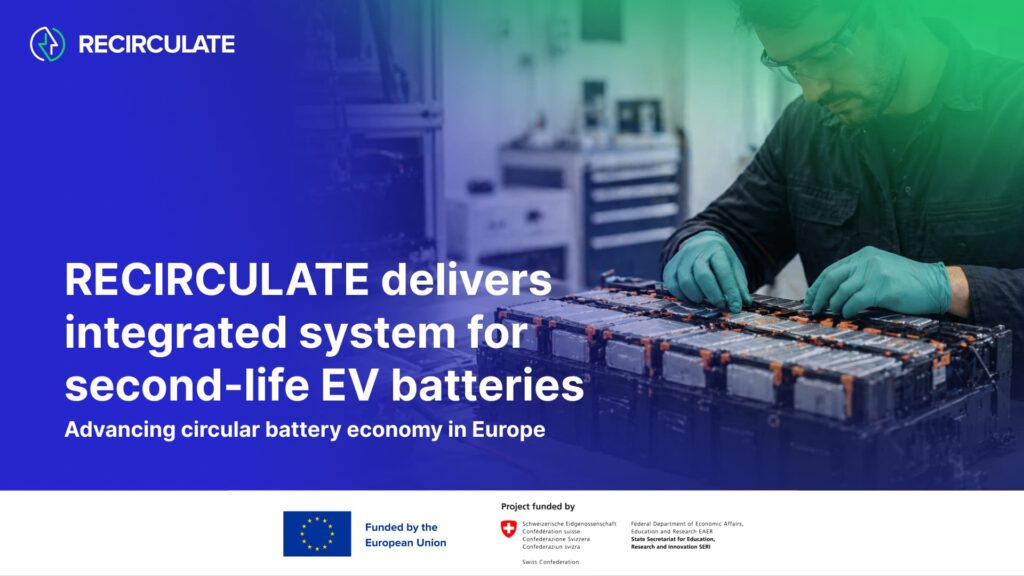
30 April 2026, Europe – After three years of research, development and real-world validation, Recirculate, an EU- and Switzerland-funded project, has successfully demonstrated a complete system for managing electric vehicle batteries at the end of their first life. The project brings together 11 industry and research partners —including EURECAT, CSEM, Centria University of Applied Sciences, DHL Supply Chain, Minespider, Ford Otosan, Probot Oy, Libattion, Eco Stor (Recube), Iconiq Innovation, and Gelkoh— to address one of the most critical challenges in the battery value chain: how to safely and efficiently extend battery life through second-life applications.
Rather than focusing on isolated innovations, Recirculate has developed an integrated approach that spans the entire battery lifecycle—from condition assessment and sorting to dismantling, reuse, transport and data management, enabling second-life batteries at scale.
From uncertainty to data-driven decision-making
A major barrier to second-life battery deployment is the lack of reliable information about battery condition. To address this, EURECAT developed advanced models capable of assessing battery health, safety, and remaining useful life within minutes—without requiring full charge-discharge cycles. This enables faster, safer, and more scalable decision-making for reuse, transport, or recycling.
In parallel, CSEM introduced rapid battery segregation methods, allowing large volumes of batteries to be grouped based on performance characteristics, an essential step for industrial-scale second-life deployment.
From testing to real-world deployment
Moving beyond laboratory innovation, Eco Stor demonstrated a fully operational second-life battery energy storage system, where batteries are tested, matched, and integrated into modular and containerized solutions ready for real-world use.
To support long-term performance, CSEM also developed an advanced battery management system (BMS) with active balancing capabilities, improving cell uniformity and extending battery lifetime in second-life applications.
Automating dismantling with AI and robotics
Handling end-of-life batteries at scale requires automation. Within Recirculate, Centria University of Applied Sciences, in collaboration with Probot Oy, developed and validated an AI-based robotic EV battery disassembly system, capable of identifying, assessing, and dismantling batteries from pack to module and cell level.
The system uses multiple machine learning models to detect components, defects, connectors, and wiring, while also determining optimal disassembly strategies. It can automatically identify battery types and select the correct dismantling process, significantly improving efficiency and safety.
This represents one of the first real-world demonstrations of AI-driven battery disassembly moving beyond research into industrial application, addressing a major bottleneck in scaling second-life and recycling operations.
Enabling safe and intelligent battery transport
Transporting lithium-ion batteries—especially used or damaged ones—remains a major safety and regulatory challenge. Within Recirculate, DHL Supply Chain, in collaboration with Gelkoh, developed smart logistics solutions combining IoT, telematics, and real-time monitoring to ensure safe transport conditions.
Building the data layer for a circular battery economy
One of the key outcomes of the project is the development of a Digital Battery Passport and a connected battery marketplace by Minespider. These tools enable structured, transparent, and accessible battery data across stakeholders, reducing uncertainty and enabling informed decisions on reuse, remanufacturing, or recycling.
By linking physical batteries with digital records, the project lays the foundation for scalable and trustworthy circular battery systems in line with upcoming EU regulations.
Building on this, Minespider launched the MVP battery marketplace Recircle.market, a digital ecosystem designed to connect stakeholders across the entire battery value chain—from reuse and refurbishment to recycling and specialised services. Fully integrated with Digital Battery Passports and Digital Product Passports, the platform enables companies to list and trade second-life batteries and materials supported by verified technical and lifecycle data, access services such as diagnostics, logistics, dismantling, and certification, and connect directly with partners.
Demonstrating real environmental and economic impact
Through life cycle assessment and techno-economic analysis led by EURECAT, the project confirmed that extending battery lifetime through second-life applications can significantly improve environmental performance. By distributing the impact of battery production over a longer service life, second-life use reduces overall resource consumption and emissions per service unit.
At the same time, the project identified key barriers to scale, including data gaps, variability in battery condition, and operational complexity—providing a clear roadmap for future development.
Media Contact:
Anastasia Popova
anastasia@minespider.com
About Recirculate
Recirculate is a collaborative EU- and Switzerland-funded project bringing together leading industry and research partners to develop technologies and systems for second-life and end-of-life EV batteries. By integrating AI, advanced analytics, robotics, and digital battery passports, the project aims to make battery reuse safer, more efficient, and economically viable—supporting the transition to a circular battery economy in Europe.