
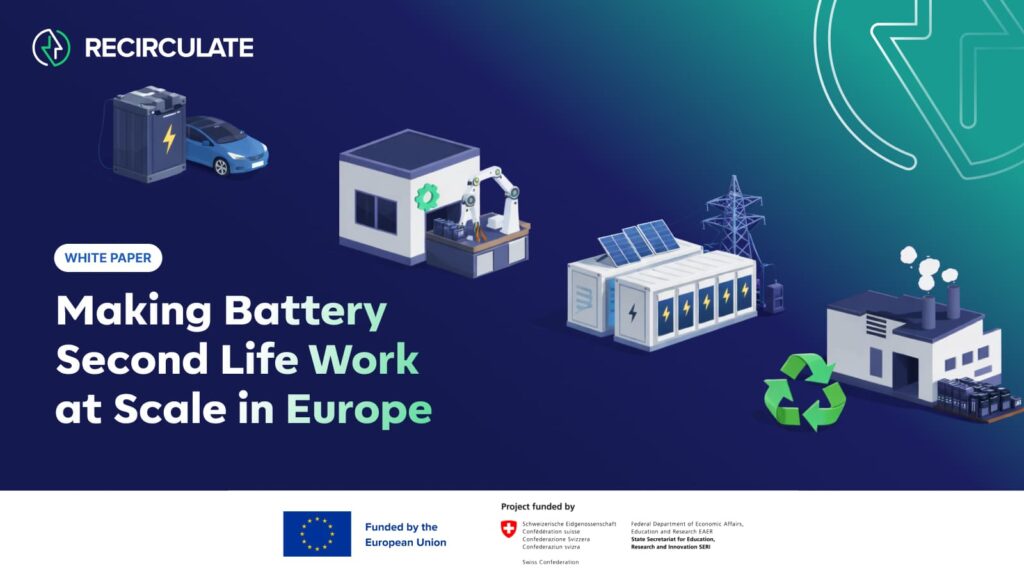
RECIRCULATE, an EU-funded initiative focused on circular battery systems, has published its White Paper on enabling scalable second-life pathways for lithium-ion batteries in Europe.
The publication consolidates key project findings on how second-life batteries can be integrated into a structured and reliable system that connects diagnostics, logistics, dismantling, reuse, and recycling decisions within a single operational chain.
The White Paper addresses a central challenge in Europe’s battery value chain: while electric vehicle batteries often retain usable capacity after their first application, recovery of this value is constrained by fragmented data, limited diagnostic speed, logistical complexity, and insufficient trust in second-life markets.
The Challenge RECIRCULATE Set Out to Solve
The European battery value chain faces multiple interconnected barriers that prevent efficient reuse of batteries after their first application. These challenges are not isolated technical issues but system constraints across data, logistics, and coordination.
Key issues include slow and inconsistent battery condition assessment, fragmented reverse logistics systems with safety and handling risks, limited availability of reliable and portable data, and operational complexity in dismantling and sorting. In many cases, batteries are routed to recycling too early, resulting in loss of usable value.
The Project’s Operating Model and Solutions
RECIRCULATE introduces an integrated operational model for second-life batteries, designed around sequential decision-making. Each battery moves through a structured pathway: assessment, routing to reuse or remanufacturing where possible, controlled dismantling if required, and recycling only when no higher-value option remains.
A Digital Battery Passport acts as the data layer across all stages, ensuring that condition and lifecycle information can be transferred between actors. This reduces uncertainty in decision-making and improves coordination across the value chain.
The system is supported by several technical components, including rapid diagnostic methods, monitored logistics solutions, AI-assisted dismantling systems at demonstration level, second-life storage applications, and early-stage marketplace concepts for structured asset exchange.
Results, Outcomes, and Lessons Learned
The project demonstrates improvements across multiple parts of the battery lifecycle. In selected pathways, diagnostic processes were reduced from hours to minutes, enabling faster classification and routing decisions. Qualification methods were also optimised to support higher-throughput assessment.
Monitored logistics systems were validated to improve visibility and safety in reverse flows. AI-assisted dismantling systems were tested in controlled environments, supporting more structured and repeatable handling processes. In parallel, second-life storage systems were deployed in pilot configurations.
A Digital Battery Passport framework was developed to support data continuity, while a marketplace concept was explored at MVP level to test structured transaction models. A key outcome across all activities is the importance of system integration rather than isolated improvements.
What the Results Mean for Europe’s Circular Battery Supply Chain
RECIRCULATE highlights that scaling second-life batteries depends on coordination across several system layers. Faster and more reliable diagnostics are required to reduce decision latency. Standardised and interoperable data structures are needed to improve trust and usability of battery information.
In addition, reverse logistics must be made safer and more transparent, while dismantling and reuse processes need to be designed for scalability. Digital infrastructure plays a central role in connecting these elements and enabling more consistent lifecycle tracking.
Overall, second-life viability depends on system integration across technical, logistical, and data domains rather than individual technology improvements.
Recommendations and Next Steps
To support scaling of second-life battery systems in Europe, RECIRCULATE identifies several priorities. Qualification methods and battery data structures should be standardised to improve comparability and reduce uncertainty in decision-making.
OEMs are encouraged to consider design principles that support both diagnosis and dismantling. Logistics operators should move toward monitored and traceable transport systems for used batteries as a baseline requirement.
From a systems perspective, future development should focus on integrated value chains rather than isolated components. Digital Battery Passports should be treated as core infrastructure for enabling trust and coordination in circular battery markets.
Finally, funding and scale-up mechanisms should support end-to-end system validation to ensure that diagnostics, logistics, dismantling, and reuse are developed as connected parts of one operational chain.
Explore the complete findings, technical results, and system-level insights from the RECIRCULATE project.
Read the full White Paper here